
• Daniel Baker
Posted in Life in the Church, Theology, Trinity Fellowship Churches
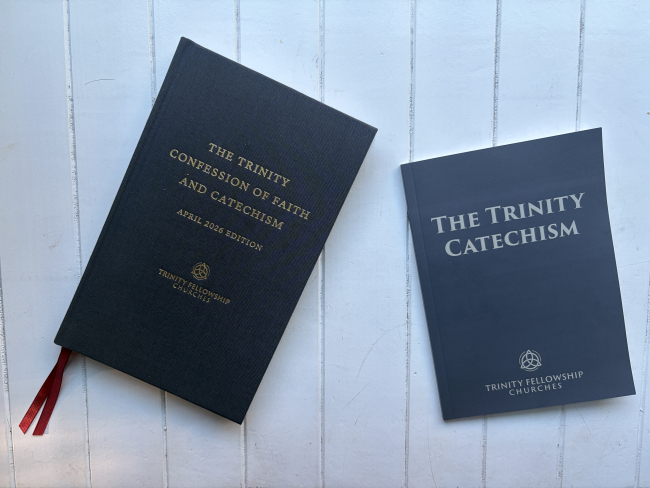
For the last couple of years, Trinity Fellowship Churches has been working on new editions of both the Trinity Confession of Faith (TCOF) and the Trinity Catechism (TC). There is a rigorous and lengthy amendment process to make changes to these documents. It takes a lot of communication among the elders and a ¾ vote by the General Assembly of TFC to make them. This is the highest required approval for anything in TFC, appropriately so. These documents are now complete and published. We’ll be working to get you copies of these as soon as possible.
For now you can see PDFs of both documents in their entirety. Here is the combined Trinity Confession of Faith and Catechism, and here is the Trinity Catechism (and here is a more interactive form of the Catechism).
We thought it would be helpful to give you some sense of what has changed (and what hasn’t!). As you’ll see, most of the changes were very subtle. But a few of them were substantive.
To explain the changes, I’ll divide them into three “levels.” Level 1 alterations are “changes to Scripture references and formatting.” These don’t really affect the content of the Confession or Catechism, but it’s still important to get all this right. These documents need to be able to be relied on, and the supporting proof texts are part of their value to our elders and members.
Level 2 amendments are “changes to wording in subtle but important ways.” Here we changed the body of the Confession by adding a word or two in some sentences.
Level 3 amendments are “substantive changes.” These impact doctrinal statements made in the Confession and Catechism that have to do with our increased understanding of certain ideas. In total, this is only about a half-dozen sentences in the entirety of the two documents. But since these changes impact doctrinal ideas in documents that are what elders are to “affirm, teach, and defend” (BCO 1.1), that’s significant.
Now for the changes.
Level 1: Changes to Scripture References and Formatting
These changes were the simplest to make and the least controversial. Some of these involves mistakes made in the first edition (2022). For instance, in TCOF 6.4 on “Divine Providence,” we used Genesis 1:20 as a proof-text instead of Genesis 50:20. Genesis 1:20 on “the waters swarming with living creatures” is a wonderful text! It just doesn’t speak to “Divine Providence” like Joseph’s famous statement in Genesis 50:20: “As for you, you meant evil against me, but God meant it for good, to bring it about that many people should be kept alive, as they are today.”
Some Scriptures were changed to provide better support for what was being stated. For instance, 1 Timothy 5:1–2 was added in the Catechism Questions 15–16 and TCOF 5.2 on what it means to be a man and a woman. Also, Revelation 12:9 was added as a footnote to the word “serpent” in TCOF 7.1.
Crossway came out with a 2025 text edition of the ESV Bible, so we made changes where our proof texts were impacted. You can see what Crossway changed here. As one example, John 1:18 in the older ESV has “the only God,” but in the 2025 edition it is “God the only Son,” a great improvement. We updated footnotes in TCOF 2.3 and TCOF 9.10 accordingly.
As needed, we also changed commas and other punctuation to make the language clearer (e.g., TCOF 3.5) and corrected various other imperfections (added/removed bold lettering in footnotes as needed, etc.).
Level 2: Changes to Wording in Subtle but Important Ways
Level 2 amendments were very slight, but they still impacted the actual content of the TCOF, so they’re worth noting. TCOF 2.3 speaks of the Trinity; and in the second to last sentence, “all are infinite, without beginning,” has been changed to, “all three are infinite, without beginning.” In TCOF 9.3 talking about Christ, “in Christ all the fullness should dwell,” has been changed to, “in Christ all the fullness of God should dwell.”
Level 3: Substantive Changes
Level 3 amendments required the most discussion by the elders. These involved four sections of the Catechism, and the first of these required changes in both the Confession and the Catechism.
Male and Female in TCOF 5.2 and TC Questions 15–16
As you might imagine, any statements that speak to the issue of sex/gender are thorny and complex. Even when people agree on the issues, it can be hard to get the language right. In the Confession and Catechism, we attempted to define what a man is and what a woman is. As God’s Word teaches, our belief is that maleness and femaleness are hard-wired by God at conception and part of all that we each are from our DNA to our relational tendencies. Yet, saying this accurately is no easy task. Our attempt is captured in TCOF 5.2. These sentences are echoed exactly in TC Questions 15–16. The new language is underlined below. You’ll notice we attempted to capture God’s created design, our respective callings/vocations, and our distinct relationships as men and women:
TCOF 5.2. Male and female are divinely-ordered sexes, designed and assigned by God for complementary roles. Both men and women are created in the image of God, equal in dignity and worth. Adam was created by God from the dust of the earth. Eve was created by God from Adam’s rib, as a helper suitable to Adam. The Sovereign Lord of history creates each person male or female, and inherent in his design are good purposes for each person. A man is divinely created male in his whole person, and his vocation as a man is to work, cultivate, and keep what is entrusted to him. He is spiritually called to be a son, brother, and father; and most will reflect this calling in the sphere of natural relations as well. A woman is divinely created female in her whole person, and her vocation as a woman is to help, nurture, and bring life to those given to her. She is spiritually called to be a daughter, sister, and mother; and most will reflect this calling in the sphere of natural relations as well.
The Holy Spirit in TCOF 10.2
In our first edition of the Confession, we borrowed language from Augustine on the Holy Spirit. After further reflection and considering that no other confession of faith had included Augustine’s idea in their teaching on the Spirit, we decided we wanted to stay with the majority and leave this idea out of our binding theological document. Of course, we did include a chapter devoted to the Holy Spirit in our Confession, and this is something no other major Confession has done.
Here is our amended statement (language struck out is removed in new edition):
TCOF 10.2. The Holy Spirit of God, the third person in the Holy Trinity, being very and eternal God, the fullness of the love between the Father and the Son, of one substance and co-equal with him who made the world, who upholds and governs all things he has made, did, when the fullness of time was come, conceive the Lord Jesus in the womb of the virgin Mary.
Saving Faith in TCOF 16.2
The change we made to TCOF 16.2 was actually going back to the Westminster Confession of Faith. Our Trinity Confession was taken from the 1689 London Baptist Confession of Faith, a document that is about 80% straight from the 1646 Westminster Confession and then 20% from either the 1658 Savoy Declaration or original to the 1689 itself. At times we have gone back to the wording contained in the Westminster Confession, and this is one of those times. We felt the Westminster Confession had a clearer statement on what saving faith is and isn’t. Here is our changed section (underlined is new language, strike out has been removed):
TCOF 16.2 By this faith, a Christian believes to be true whatever is revealed in the Word as the authority of God himself; and he perceives an excellency in it above all other writings and all things in the world, for the Word bears forth the glory of God in His attributes, the excellency of Christ in His nature and offices, and the power and fullness of the Holy Spirit in His workings and operations.
So the Christian is enabled to cast his soul upon the truth that he believes.
By this faith, he also acts differently based on what each particular passage contains: obeying the commands, trembling at the warnings, and embracing the promises of God for this life and that which is to come.
But the principal acts of saving faith have immediate relation to Christ—accepting, receiving, and resting upon him alone for justification, sanctification, and eternal life, by virtue of the covenant of grace.
Taking the Lord’s Supper in a Worthy Manner in TCOF 32.8
Our final change was concerning the Lord’s Supper and what it means to take it in a “worthy manner” (1 Cor 11:29). Here we brought in some language and ideas from the previous version of the Catechism that speaks to the same issues. The previous version of the Confession used “ungodly persons” when “unbelieving persons” was meant, and we felt this was confusing. We all feel “ungodly” when we confront Christ in the Supper, but that idea isn’t what is meant. “Unbelieving persons” is what was originally meant, so we changed that language and added a final new sentence:
TCOF 32.8 All unrepentant or unbelieving persons are unfit to enjoy communion with Christ and are therefore unworthy of the Lord’s table and cannot partake of these holy mysteries without great sin while they remain in their unrepentance or unbelief. Indeed, whoever receives it in an unworthy manner is guilty of the body and blood of the Lord and eats and drinks judgment on himself. Instead, a Christian must receive the Lord’s Supper with sincere faith in Christ, true repentance, a discernment of the body of Christ, and unity of spirit with our brothers and sisters in Christ.
Going Forward
Our sense is that with the 2026 Confession and Catechism, these documents won’t be changed for a good while. The last seven years of analysis and editing has invovled no small effort to get these two documents into their current state, and we feel there is reason to hope they are fairly stable documents at this point. Only God’s Word is “inerrant” (without error), though, so we know we may need to make changes down the road.
May God use these documents to protect and inspire his church and the elders and members of Trinity Fellowship Churches for decades to come.
Daniel
Previous Post